
August 2026 Property Market Update: More Power for Buyers and Borrowers

A softer market is giving prepared buyers more room to negotiate and borrowers more leverage with lenders.
Author: Peter Vassilis
Reading time: ~5 minutes
Key takeaways
Sydney home values fell 1.4% in July, 5% below their January peak, according to Cotality.
Domain is reporting 54% auction clearance rates, compared with 75% this time in 2025.
Upsizers are benefiting, with the more expensive properties falling.
The number of new home loans fell 5.4% in the June quarter, increasing the pressure on lenders to compete for good borrowers.
First home buyer support is helping the lower-priced end of the market remain more resilient
Property prices down
As was widely expected, the Reserve Bank (RBA) held the cash rate at 4.35% in August after three increases during 2026. It noted that housing prices were falling in capital cities and new housing loans had declined. The dip, as it’s been referred to in previous monthly updates, continues.
Cotality reported Sydney values fell 4% in three months, to July.
Domain's preliminary Sydney auction clearance rate is hovering around ~50%, down from ~70% a year earlier, meaning we’re selling roughly 50% of the properties that go to auction.
The downturn is believed by economists to stem from the RBA’s earlier rate rises and tax changes announced in the May 2026 budget.

Will spring bring change?
Spring usually brings more homes to market. This year, the increase may be more restrained.
Cotality has observed a fall in the flow of new listings, led by Sydney, as owners wait for conditions to improve. Domain has also reported that available stock remains lower than a year ago.
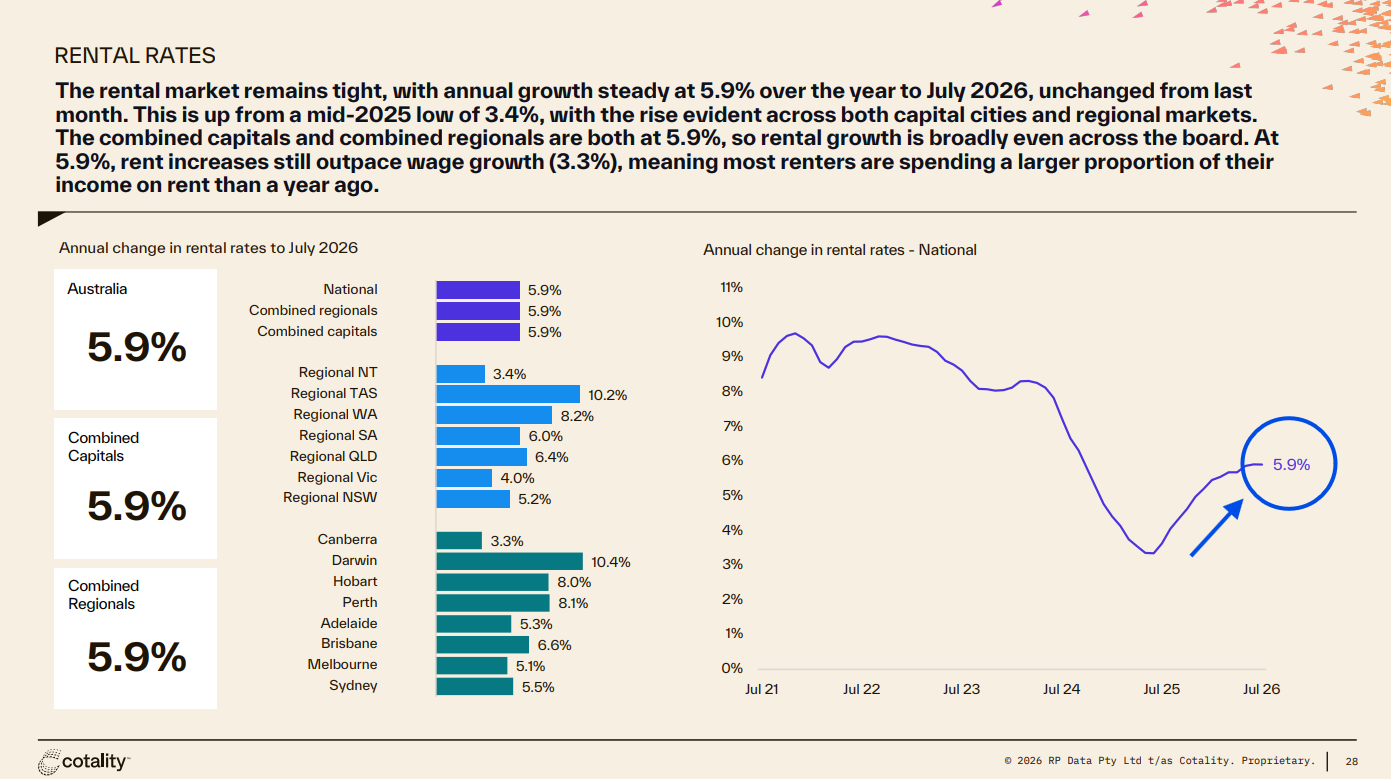
Investors have another reason to consider holding. National rents were 5.9% higher through July, and properties held before the Federal Budget announcement are also protected from the new negative gearing restrictions.
Under the current rules (post-2026 budget), if you buy an established property now, you cannot offset rental losses against your wage income to reduce your end-of-year tax bill. In our view, the combination of stronger rents and grandfathered tax treatment may reduce the pressure on some existing investors to sell.
How a softer market can favour upsizers
For downsizers, the risk is that your existing home sells for less than the recent data suggests. For upsizers, this market is genuinely working in your favour.
Sell your current home at a 5% discount. On a $1.5m home, that is $75,000 less in your pocket.
Buy the bigger home at a 5% discount. On a $2m target, that is $100,000 less out of your pocket.
You are $25,000 ahead on day one. When the market turns and grows by 5% in the long run, the bigger asset also grows in bigger dollars.
Add two things people often don’t focus on:
No capital gains tax on the sale of an owner-occupied property, and it is not included in Age Pension asset tests.
The risk is still real, and your circumstances need to be considered. There are right ways and wrong ways to move between two properties, and we have seen people make expensive mistakes before talking to us. If it is something you are thinking about, we can walk you through how to reduce that risk.
First home buyer support, cushioning the lower end
The Australian Government 5% Deposit Scheme has no income caps or limit on places. In Sydney, the property price cap is $1.5 million. Eligible buyers can purchase their first home with a 5% deposit without paying lenders’ mortgage insurance. This is the federal support available.
At a state level, the NSW First Home Buyer Assistance Scheme (Stamp Duty initiative) is allowing exemptions up to $800,000 and a concession above $800,000 and below $1,000,000.
These initiatives are keeping this part of the market a little more buoyant, while the top end softens. First home buyers still need a buffer, a realistic repayment plan and confidence that they can hold the property if values move lower.
Banks are hungry
Borrowing figures are down, so competition between lenders has heated up. New home loans fell 5.4% in the June quarter. Investor loans recorded the largest fall, down 8.6%, according to the Australian Bureau of Statistics (ABS).
In our 6-monthly reviews we do for all our existing clients, we’re negotiating existing borrower rates that are at the same level as what a new-to-bank borrower would get. This is not typically the case; banks are usually able to offer new-to-bank borrowers more competitive rates than existing borrowers, in an attempt to get new borrowers in the door.
Bank turnaround times on applications are at lightning speed. That usually means back offices are quiet and hungry for volume.
Banks are under profit pressure, so they are getting more aggressive on price to improve volume in, and more creative on policy. Expect more niches, more reasons to say yes.
If you are a borrower or a buyer, you are in a position of power.
Final thoughts
Sydney's market has cooled, but it has not stopped. Our view is that this will still be a dip, not a crash. Prepared buyers have more time and negotiating power. For upsizers the math is on your side. Downsizers or sellers need accurate pricing on their property value or price, and prudence in their approach. Investors have more reason to hold and First home buyers will continue to be supported by the federal and state initiatives. All borrowers have more negotiating power for a better deal.
The best opportunity depends on your own numbers, your own circumstances, and what is in your best interest.
If you are considering buying, selling, upsizing or reviewing your loan, we can help you model the options before you commit.
General information only. This article does not consider your objectives, financial situation or needs. Property, lending, tax and social security outcomes depend on individual circumstances. Seek appropriate advice before acting.
Frequently asked questions
-
In many segments, buyers have more negotiating power because values, auction clearance rates and loan demand have fallen. It is not uniform. Scarce, well-located homes can still attract strong competition.
-
If both properties fall by the same percentage, the dollar saving on the more expensive home is larger. In the example above, a 5% fall reduces a $1.5 million sale by $75,000 and a $2 million purchase by $100,000, improving the price gap by $25,000 before costs.
When the market grows, a more expensive property grows in value by more, if the same percentage of growth is earned across the market. -
If the property was acquired after the 12 May 2026 Budget announcement, rental losses can generally offset salary and wages until 30 June 2027. From 1 July 2027, the losses can generally only offset other residential property income, including capital gains, with excess losses carried forward. New builds and pre-announcement holdings have different treatment.
-
A review is worthwhile, but refinancing is not always required. Your existing lender may improve the rate. Compare the full loan structure, fees, features and switching costs before making a decision. We do 6 month reviews for all our existing clients.